
By Vince Andrich, founder of Andrich Fitness Group
Taking your brand beyond selling direct to consumer (DTC) from your website to another retailer or distributor is a business decision before it is a sales decision. That’s because each sales channel and retailer has its own cost structure: payment terms, profit margins and unit velocity targets, plus promotions, trade budgets, and fees for returns and late shipments, just to name a few.
These specifics must be mapped against your current suggested retail pricing, product costs and overhead to be sure you’ll be profitable. Build that math on a worst-case scenario, not to be negative, but to be prepared for success.
Expanding into new forms of distribution means doing that work each and every time, all while considering cash requirements, and your current sales in the accounts you already have. That’s because adding new sales accounts when your current accounts aren’t strong enough can weaken your brand instead of building it.
Most founders treat retail as a meeting to win. That is the cheap part. The expensive part is everything on either side of it: showing up with a price structure that survives channel margins and moving product once it is on the shelf.
This guide covers what it takes from the owner’s chair, and when it makes sense to bring in a broker to navigate buyers, terms and contracts.
The short version
- A shelf gives you access to shoppers. It does not create demand. That is still your job.
- Retail is a margin decision. The retailer, the distributor and your promotions all come out of your profit before you see a dollar.
- Buyers decide on velocity, margin and trade support. Formula quality is assumed.
- Distributors and retailers are different sales. Most brands need both.
- Expansion is not copy-paste. Each new retailer has its own shopper, terms and review calendar.
- Going in unprepared costs you a year. Most chains review each category on a fixed schedule, often once a year (the line review), and that calendar does not wait.
In this guide
- What does it take to sell into a retailer?
- Should you sell to retailers directly or go through a distributor?
- How much does a supplement sales broker cost?
- Is your brand ready for a retail broker?
- How do you choose a supplement sales broker?
- How does Andrich Fitness Group represent brands?
- Frequently asked questions
- Apply for designation
What does it take to sell into a retailer?
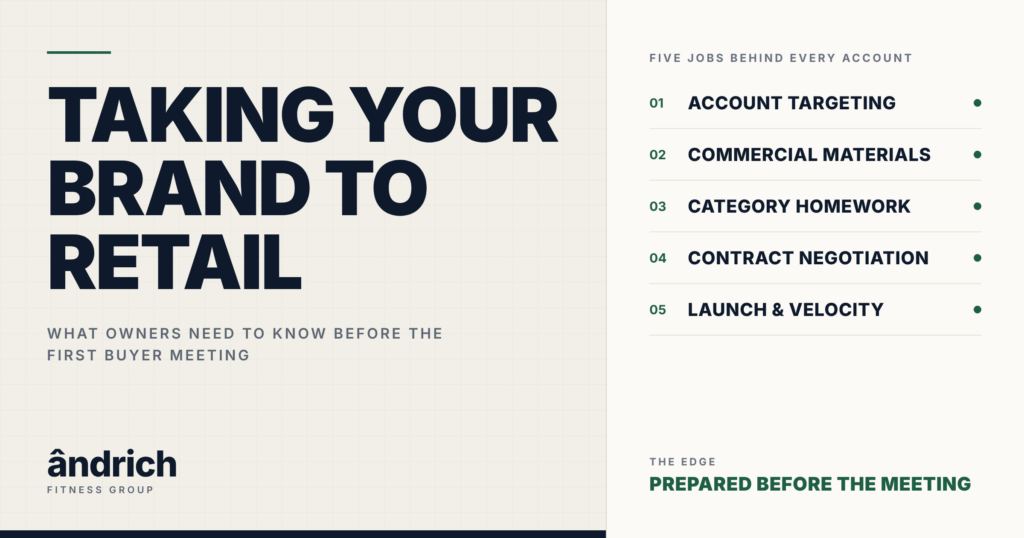
Selling into a retailer takes five jobs: choosing the right accounts, building the buyer pitch, doing your category homework, negotiating the contract, and managing the account after launch. Most owners plan for the meeting and underfund the rest, and the rest is where the money is made or lost.
Account targeting
Ask yourself which retail accounts, channels or distributors are best suited to expand your brand beyond its current placement. The key distinction: are you expanding in the same channel, such as another online partner, another specialty retailer or another mainstream account, or are you going from direct online to brick-and-mortar retail, or from a specialty account to a mainstream account?
For example, if you currently sell only direct to consumer from your own website and want to add Amazon, you’ll want to pick the products you want to sell to Amazon strategically. Sometimes your entire catalog makes sense. Other times it makes sense to have your older or less exclusive products on Amazon so that your latest products are offered on your website first.
Adding accounts in the same channel
If you are adding an account in the same channel, you need to estimate how much sales could drop at your existing accounts in that channel, because the new account may split the same pool of customers instead of converting new ones. The best practice is to add accounts in the same channel only when sales velocity in your current accounts delivers enough revenue and profit that those buyers would find it hard to reduce your facings (shelf space), even if your sales dip slightly.
I’ve seen brands lose 10–20% of their sales at an account after expanding, and the buyer still waited patiently for them to swap lower-selling SKUs for new ones, because the brand simply made the account too much money. That is brand strength and good business.
Moving from specialty to mainstream
The calculation gets a bit more complex when going from a specialty account to a mainstream account or when crossing all the way over to club stores. First, this transition will surely alter your price-value equation and the psychographic profile of the target consumer.
Going mainstream, or ‘mass market,’ requires lower price points or much greater value than the same or similar product when sold in a specialty store. This is the fundamental operating principle for mass merchandisers: take a popular product and simply sell it for less.
This causes ‘channel friction,’ a classic marketing problem that involves the 4Ps: product, price, place and promotion. As a brand, this matters because offering your product for less can cause specialty retailers to de-emphasize your brand because they are losing customers on price.
These retailers attract consumers who either already understand and use products like yours or are highly motivated to learn about these products and want to shop for them where like-minded people shop. It’s like a runner shopping at a store for runners vs. Walmart.
Commercial materials
Selling into a new channel, account or distributor is a combination of art and science. At the core, you will be presenting product assortment, sales and profit data from the channel or account you’re already successful in.
Your brand story must convince the buyer that bringing in your products will get their current customers to buy more and new customers to begin shopping in their store instead of a competitor’s, because your brand appeals to them or your product selection and pricing offer more value.
When selling to a brick-and-mortar account, be sure to emphasize how your brand will drive customers to their stores. This is where great sales data from direct-to-consumer or Amazon must be connected to how you acquire new customers on those platforms, and how you will do the same for them.
Ultimately, your brand will be graded on how well it delivers more customers, repeat sales and profit to their company. In practice, that story lives in a buyer deck, a sell sheet, a price list and a promotional plan, all written for the buyer, not the consumer.
Account and product category homework
Before getting any appointment with the buyer at your target account, you must do a thorough analysis of which section of the store you want to be placed in, and which marketing platforms and fees come with it.
For example, years ago, my distribution company sold into Albertsons grocery stores. We did this through a direct-store-delivery (DSD) program, which lets local or regional brands earn shelf space without going through the chain’s corporate distribution system. Think of it as a way for big chains to test new products and support local suppliers or brands with a local following. This was in 1988, when getting sports supplements into grocery and mass merchants was a big deal.
When I asked my contact whether a 40–45% gross margin was acceptable, he said that in the over-the-counter medicine and health section we were going into, 40% was phenomenal. He then told me how temporary price reductions (TPRs) worked and how I could use coupons at events to drive customers to his store. Those coupons would come back to us as deductions.
That education let me give the account a solid go-in margin, with enough profit left over to fund the programs that pushed us past our velocity targets and made us category captain (the supplier the chain trusts to help plan the whole section) for the entire chain.
Learning the retailer’s programs and fees
Today, large retailers like Amazon and Target run their own advertising platforms or have close ties to preferred ones. Amazon has Amazon Ads (formerly Amazon Marketing Services), and Target has Roundel, its in-house retail media network, where vendors buy sponsored product ads on Target.com and the Target app, plus offsite display, social and streaming TV campaigns built on Target’s shopper data.
Buyers expect that spend to support your launch, so build it into your trade budget before the first meeting.
Contract negotiation
As you probably know, moving into larger retail accounts requires contracts, and no two are the same. Many of the price, margin, marketing and promotional costs discussed earlier will be addressed in the vendor agreement. This is also where you will find the details on promotional calendars, slotting or placement fees, payment terms, returns, and markdown or accelerated sales programs to move dated or slow-moving inventory.
Read just as closely for the costs that never appear on a price sheet: compliance chargebacks for late or short shipments and labeling errors, unsaleable or damage allowances, free fills for new stores, product liability insurance naming the retailer as an additional insured, indemnification, and what happens to unsold inventory if you are discontinued. For supplements, expect third-party testing and quality documentation requirements as well.
Before signing off on your cost to the account, review your walk-away numbers, listing every added fee, plus the extra investment it will take to keep the account healthy and growing.
Realize that you are not just selling to an account. You are buying a sales asset that includes shelf space and a customer base that is also looking for products like yours. This is what you hoped for, so be clear-eyed about your numbers and the sales velocity it will take to make that account a success.
Launch and velocity management
Modern-day account management requires working with your leadership team to coordinate shipments, go-to-market launch plans, product setups, and social media and online collaborations. You will own the sell-through data, fix corporate- and store-level out-of-stocks, and defend your placements at the next category review.
While you manage your current set, you also must plan upcoming sales and marketing events, like Black Friday/Cyber Monday, and push your product and marketing teams for the information you need to sell in new products or flavors at your next meeting.
Velocity is the number every buyer reviews, so track it weekly by store and act on slow doors (individual stores) before the buyer has to ask. Spotting weak performers early gives you the data to plan replacements, called swaps, with your buyer, so you can keep competitors from taking your slots.
Someone has to own each of these jobs, whether that is you, your team or a broker, and none of them creates consumer demand on its own. That stays with the brand: the promotions, the trade spend and the reasons for shoppers to look for you on that shelf.
If nobody is asking for your product, you can get it on the shelf. Nobody can keep it there.
Should you sell to retailers directly or go through a distributor?
Most sports nutrition brands need both, because they reach different doors. National chains buy direct from the brand at the category-buyer level. Distributors are how you reach the thousands of independent supplement stores, gyms and regional accounts that no brand can service one at a time.
| Retail chain, direct | Distributor | |
| Who buys | Category buyer at headquarters | Purchasing team at the distributor |
| Who you reach | That chain’s stores and its website | Independent retailers, gyms, regional chains, online resellers |
| What they need from you | Velocity proof, margin, promo calendar, in-store support | Pull-through demand, clean pricing tiers, reliable fill rates |
| Your margin | One layer between you and the shelf | Two layers: distributor, then retailer |
| Typical failure | Placement with no trade or traffic-building plan behind it | Authorization with no reorders, tiered programs or samples to get retailers trying and selling your brand |
The failure in the last row is the one founders underestimate. A distributor authorization is permission to be ordered, not an order. Stores still have to ask for you.
Pricing is where this breaks. If your wholesale price only works when you sell direct to consumers, it will not survive a distributor margin plus a retailer margin plus promotions. Fix the price ladder before the first buyer meeting. Rebuilding it after is how brands lose their first account.
How much does a supplement sales broker cost?
Brokers are paid a commission on net sales, a monthly retainer, or a combination. Published market ranges put commission at roughly 3% to 7% of net sales, with natural and specialty channels at the higher end, and retainers anywhere from a few thousand dollars to $15,000 a month (FemFounded, JD All Thomas).
Which structure fits depends on one thing: whether demand already exists.
| Retainer + commission | Commission only | |
| Fits | Brands with no US distribution yet | Brands with verified US demand |
| Why | The broker is building the market from zero, months before any sale | There is velocity to sell against, so the work pays for itself |
| Your risk | Fixed cost before revenue | Low cash risk, but brokers prioritize lines that already move |
| Broker’s risk | Low | Carries the full cost of the sales cycle |
A commission-only broker is not free. If your line is slow, you become the last sell sheet in the bag. A retainer buys attention during the months when there is nothing to earn commission on.
Broker fee vs. the alternatives
The better way to judge a broker fee is against what it replaces. When I ran a distribution company, I was always looking for the right time to move brands I carried into direct distribution with a chain. Once a brand was set up in the retailer’s corporate warehouse, I would step back from distributing it and represent it as a broker instead.
My gross profit as a distributor was higher than my fee as a broker, but the brand saved money by cutting out the distributor’s margin, and that savings could go to better consumer pricing, a stronger brand margin or marketing costs. Holding on to the distribution would have cost the brand more and weakened its position on the shelf.
A broker also costs less than in-house headcount. A full-time account manager for a larger account can run over $150,000 a year plus benefits and travel, and some accounts need one to three of them. A broker arrives with the buyer relationships already in place.
The bigger difference is mindset. An employee is paid for time. A broker who thinks like a brand owner is paid on results and measures every decision against the same thing you do: profit.
Four terms to settle in writing before signing
- The definition of net sales. Before or after promotions, returns and chargebacks.
- Which accounts are covered. Named accounts, not “the channel.”
- Performance expectations. What happens in the first 90 days.
- The exit clause and tail. Both sides should be able to leave without a twelve-month lock. In return, expect a tail: a reduced commission for a set period, such as six to twelve months, on the accounts the broker opened. It is fair pay for building an account you keep, and it keeps the broker invested in a clean handoff.
Is your brand ready for a retail broker?
Your brand is ready for a broker when it can answer four buyer questions with numbers. Buyers assume the formula is good. They are deciding whether your product will earn more per inch of shelf than what it replaces.
- Is there demand? Direct-to-consumer velocity, reorder rate, regional sell-through, or search and social pull. Something a buyer can verify.
- Do the margins hold? A price ladder that leaves room for the retailer, the distributor, the broker and a promotional calendar.
- Can you supply it? Production capacity and lead times that survive a chain-wide order and the reorder after it.
- Will you support it? A trade budget and a founder who shows up: promotions, in-store education, creator and athlete activity pointed at that retailer.
If one of these is missing, fix it first. A broker pitching a brand that is not ready burns the meeting, and buyers remember.
The portfolio question comes before the pitch. Buyers do not want your whole line. They want the two or three SKUs that will turn. Leading with the hero SKU and holding the rest back is usually the difference between a test and a pass.
Not sure how your brand answers those four questions? That is exactly what our 30-minute readiness review is for. See Apply for designation below.
How do you choose a supplement sales broker?
Choose a broker on category experience, bandwidth and what they will commit to in the first 90 days. The size of the brokerage tells you very little. A large firm with 60 lines gives yours a sixtieth of its attention.
Five questions to ask before you sign:
- How many brands does the person on my account carry? The person, not the firm.
- Which buyers in my category have you sold to, and what did you place? Named placements, not a logo slide.
- Do you carry a competing line? If so, ask who gets pitched first.
- What will be done in the first 90 days? Accounts, meetings, materials, dates.
- Have you worked on the brand side? A broker who has owned a P&L prices and negotiates differently from one who has only sold.
The mistakes that kill placements:
- Pitching the product instead of the category. The buyer’s question is what your item does for their set, not what it does for the consumer.
- Bringing the whole line. Every extra SKU dilutes the ask.
- No trade plan. Placement without promotion is a slow delisting.
- Going quiet after the purchase order. The second order is the one that matters, and it is earned in the first 12 weeks on shelf.
How does Andrich Fitness Group represent brands?
Andrich Fitness Group represents a small number of sports supplement and functional food or RTD brands to US retailers and distributors. We take brands by designation, not by signup: we review every brand before taking it on, because a short roster is the only way each line gets sold properly. Ask us the five questions above. We expect to be judged on the answers.
Why us: For 25+ years, I’ve built and run the programs behind championship brands at Quest Nutrition, Bang Energy, JYM Supplement Science, PROGENEX, GNC, EAS and MET-Rx. We have sat on the brand side of these buyer meetings, which is why we build the price structure and the trade plan before we book one.
We work like brand owners, not employees. That means recommending the path that makes both of us the most money over time, including going direct when it beats paying a middle layer, even when that lowers our fee.
Every brand we represent is on a step-down program customized to that brand, so as your sales go up, your cost per dollar of revenue goes down. Profitable partners stay partners, and long relationships are where both sides make their money.
Where we sell
- Retailers: GNC, Vitamin Shoppe, Vitamin Discount Centers, Sprouts
- Distributors: DNA, NY Barbell, MuscleFoods, Eurpac
- Food, drug and mass (FDM): Ask for our current account list
How the engagement runs
- Readiness assessment. Demand, margins, capacity, trade commitment.
- Account targeting. Which accounts and channels, in what order, with which SKUs.
- Commercial materials and category homework. Buyer deck, sell sheets, price ladder, and the category’s marketing programs and fees.
- Buyer meetings and contract negotiation.
- Launch and velocity management. Weekly velocity tracking, swaps and account defense.
Two ways to work with us
- Retainer + commission for pioneering brands with no US distribution.
- Commission only for brands with verified US demand.
In-store advocate teams and demos
Velocity is built store by store, so we also help brands build in-store advocate teams. We work with your social team to recruit geo-targeted fitness advocates, often athletes and creators already in your community, who visit stores to drop off samples and materials and build real relationships with store associates, where the retailer allows it.
A typical advocate makes four store visits a day for $75 to $120, paid by the brand, and we take no fee on the program. Associates recommend the brands they know, and those relationships keep a new line moving between promotions.
Formal demo programs work, but they are priced for big budgets. A national demo company typically charges $300 to $700 per four-to-eight-hour shift, and a multi-store program can run $1,500 to $5,000 per store (T-ROC). That is worth it when a retailer is running a major reset or promotion. For steady velocity between promotions, a handful of advocates making short store visits costs a fraction of that.
Frequently asked questions
What is a supplement sales broker?
An independent sales agent who represents a supplement brand to retail buyers and distributors, paid by commission, retainer or both. The broker never takes ownership of the product.
How much commission do supplement brokers charge?
Published ranges run from about 3% to 7% of net sales. Natural and specialty channels sit at the higher end. Early-stage brands often pay a monthly retainer as well, and well-structured agreements lower the rate as sales grow.
What is the difference between a broker and a distributor?
A distributor buys your product, warehouses it and resells it to stores. A broker sells on your behalf and never owns inventory. Many brands use a broker to win distributor authorizations.
Do I need a broker to get into GNC or Vitamin Shoppe?
No retailer requires one. A broker supplies the buyer relationship, the timing and a pitch built for a category review, which is what most first-time brands are missing.
When is a brand too early for a broker?
When it cannot show demand a buyer can verify, or when its pricing cannot absorb retailer and distributor margins. Fix those first.
How long does it take to get on the shelf?
It depends on the retailer’s line review calendar. Plan for months, not weeks, between first pitch and product on shelf.
Should I pay a retainer or commission only?
Commission only fits brands with existing US demand. A retainer fits brands with no US distribution, because the broker is building the market before there are sales to earn on. Look for a structure where the commission rate steps down as sales grow, and a fair tail on the accounts the broker opened if you part ways.
Can an international brand use a US broker?
Yes. A brand with no US distribution is the standard case for a retainer plus commission arrangement, provided production capacity and US pricing are in place.
Apply for designation
A great product does not sell itself onto the shelf. Somebody has to sell it, and somebody has to keep it there.
If you run a sports supplement or functional food brand and want US retail and distributor representation, apply for designation. The first call is a 30-minute readiness review: demand, margins, capacity, and which accounts make sense first. Whether or not we work together, you will leave knowing where your brand stands and what to fix before your first buyer meeting.
Apply for Designation: book the 30-minute call
See the full US Retail Broker Representation program
Sources
- Retail Broker: What They Do, Cost, and How to Find One (FemFounded): commission and retainer ranges
- How Food Brokers Get Paid (JD All Thomas): commission range, hybrid structures, exit terms
- What Is a CPG Broker? (The Big Box Broker): readiness criteria and red flags
- In-Store Demo Services: Complete Guide + Pricing (T-ROC): per-shift and per-store demo costs
- US Retail Broker Representation (Andrich Fitness Group): accounts, process and pricing paths
