
By Vince Andrich, founder of Andrich Fitness Group
The short version
A brand advocacy program is a managed roster of verified athletes, coaches and customers who put their own reputation behind your product, tracked by code and link so you know which ones sell. It differs from influencer marketing in one way: the same trusted voices show up season after season, instead of a single paid post that fades in a day.
A good program does two jobs. First, it builds a tiered, athlete, physique, health and fitness lifestyle grounded community, which creates credibility, trust, advocacy and awareness. Second, if you sell to brick and mortar accounts that specialize in selling your products, the grass roots stores like GNC, Gyms, Independent Health Food Stores and Vitamin Shoppe, it adds a tier of in-person advocates who visit these retailers to touch base, hand out samples and talk with sales associates. This informs the people who interact with your potential customers about your products, making them feel confident about recommending them, and good about the brand. To run either job, choose category-native advocates, verify they are real before anyone is contacted, put the terms in writing, and measure every advocate by sales. Brands that skip any one of these usually end up paying for reach that never turns into revenue.
This guide is written for owners and executives. It covers what a program is, who belongs in it, how to vet creators, how to structure sponsored athlete teams, how a store-route tier of in-person advocates works, what the contract must say, how to measure results, and when it makes sense to hand the work to an operator.
Why most influencer spend buys reach, not revenue
Health and performance buyers are skeptical by nature. They have seen every paid shout-out, and they can tell when a creator has never touched the product. Reach is easy to buy. Belief is not, and belief is what moves a serious lifter or a contest-prep athlete to switch brands.
The pattern we see across the category comes down to four failure points.
You pay for an audience that does not exist
Inflated follower counts and bought engagement are common enough that the FTC now treats them as a legal issue. Its Consumer Reviews and Testimonials Rule, effective October 21, 2024, prohibits buying or selling fake indicators of social media influence, such as followers generated by bots or accounts not tied to a real person (FTC Q&A). Hiring a creator who happens to have fake followers is not itself a violation under the rule, but it is still your money going to an audience that cannot buy.
The creator does not fit the buyer
A large lifestyle account is not an athlete, physique competitor, a coach or a serious lifter. The follower count is real and the credibility is not. Your buyer asks one question: does this person actually train and eat the way I do?
One post, no program
A single sponsored post fades in a day. Advocacy compounds only when the same voices show up consistently, so the audience hears the recommendation many times from someone they already trust. Consumers trust people they know more than any form of advertising: in Nielsen’s 2021 global study, 88% said they trust recommendations from people they know above all other channels (Nielsen). A good advocate becomes a person the audience feels they know.
If paid posts are where your money has been going, I would move much of it into podcasts hosted by trusted health, sports, fitness, nutrition and exercise voices. A host-read ad is far stickier than a post you swipe past. Listeners choose the show and stay with it for long stretches, often in the car, at the gym or on a walk, with no feed to flick through. The host delivers the message in their own voice, to an audience that already trusts them, and the episode keeps working long after release because people go back to the archive. A post is gone with a swipe. A host who tells their audience what they use and why is a recommendation, not an impression. Our podcast advertising service is built around exactly that.
Nobody owns the work
Outreach, contracts, deliverables, discount codes and reporting land on a founder or an overloaded marketing team. The program stalls in month three, and the brand concludes that “influencers don’t work.” The channel was never the problem. The program had no owner.
Sell community, not paid influence
A product with a list of ingredients competes on formula, price and shelf position, and all three can be copied. A brand that stands for something is much harder to copy. Your brand represents standards, principles and a mission, and that is what makes people want to belong to it.
This is not a fad
Many company owners view influencer marketing and advocate communities as a modern, tech-driven fad. The truth is, at its core, this strategy is just word-of-mouth advertising, a practice as old as selling itself.
If you think scaling a grassroots advocate community is a new concept, look no further than the origins of Blue Ribbon Sports, the company that would later become Nike. Founded in 1964 by Phil Knight and his legendary track coach, Bill Bowerman, the brand practiced what we now call influencer marketing long before the internet existed.
In his memoir Shoe Dog, Phil Knight details the strategic brilliance of partnering with Bowerman. Knight didn’t just gain a co-founder who understood the biomechanics of lightweight footwear; he gained the ultimate trusted authority figure. Bowerman used his own elite athletes as “guinea pigs” for his shoe innovations, product-seeding his prototypes directly to the runners who would go on to compete in the Olympic Games. By leveraging the ultimate coach-recommended stamp of approval and putting the product on the world’s most influential feet, Blue Ribbon Sports built a masterclass in athletic advocacy, a blueprint that functional food and sports nutrition brands can still use to win today.
Paid influence rents attention. Community builds believers.
Paid influence borrows someone else’s audience for a moment and stops when the budget does. A community is an audience you build and keep: customers, coaches, athletes and newcomers who believe in what the brand stands for and would talk about it whether or not they were paid. A well-run program includes paid and sponsored people, but the goal is believers, not a rented crowd.
Why lifestyle matters commercially
A community turns a product into a lifestyle brand. People do not only buy protein or pre-workout. They buy the identity, the habits and the group that come with it. The commercial proof shows up in repeat purchase, which is what pricing power rests on: customers who keep coming back do not need a coupon to do it. Repeat buyers also lower your blended acquisition cost, because every dollar spent to win a customer is spread across more orders.
Thorne is the clearest public example. Its 2022 annual report showed 57.3% of direct-to-consumer sales coming from existing customers, about 35% of sales from recurring subscriptions, and 88% annual retention of its connected health professionals, a network of more than 47,000 doctors, dietitians, trainers and other practitioners. The brand pairs that trusted network with micro-influencers and podcasts. In August 2026, Procter & Gamble agreed to buy Thorne for $3.8 billion in cash, about 5.8 times its projected 2026 sales of $650 million (SupplySide), up from the $680 million L Catterton paid to take it private in 2023 (Nutritional Outlook). The deal is expected to close in the fourth quarter of 2026.
AG1 followed the same sequence. With no money for advertising, its founder first put product in the hands of trainers, nutritionists and sports doctors, which earned the trust of early customers and opinion leaders. It then scaled with host-read ads across hundreds of podcasts (Sirka). Its CEO says revenue has more than tripled in the four years since she joined (Forbes).
Neither company publishes its promotion rate or acquisition cost, so read these as evidence that the model works at scale, not as proof of a specific number. The pattern is consistent: trusted people first, a community around them, and reach on top.
Awareness is never free
Some brands see advocates as an unnecessary cost, especially when one or two big personalities already carry the audience. Every brand needs awareness and reach, and barring a few oddities, it is never free. If you are not paying creators, you are paying for ads, for placement, for events, or with the founder’s own time. The real question is not whether to spend, but where the spend compounds. A paid post or an ad buy resets every month. A community keeps building on itself.
There is also a dependency risk. When the audience belongs to one or two people, the brand is borrowing its growth, and the brand’s future is tied to that person’s schedule, interests and goodwill.
No one or two people appeal to everyone
Influence is following someone you would like to be, or someone you identify with. No single person is that for every buyer. A founder or star athlete can be the best seller a brand has and still be one voice, with one story, speaking to one kind of customer.
This is where programs break down. Some brands built around a star want every other advocate to sell exactly the way the star does, or not at all. That caps the audience at the people who already relate to the star. Other brands see what a wider roster can do and decide to build a community.
The model comes from advertising’s old slice-of-life approach, familiar from household product ads: show different people with different problems, so every viewer sees someone like themselves. Apply it to your roster:
The competitor preparing for the stage
The coach who teaches beginners from scratch
The busy parent getting started
The PhD, Elite Coach, nurse or dietitian who explains the science
The person who lost the weight and kept it off
The newcomer who just found the gym
Each has a different background, a different reason for using the product and a different problem it solves. Together they let a much larger share of your market find a reason to belong. Keep the star as the anchor, and build the community around them. A big voice is an asset. A single voice is a ceiling.
What a real advocacy program looks like
A program is a structure, not a campaign. It gives every level of your community a reason to represent the brand, from an elite competitor on stage to a customer posting a gym selfie. The strongest programs in sports nutrition run on tiers working together, and the tiers double as a ladder: advocates move up the community for more perks as they perform.
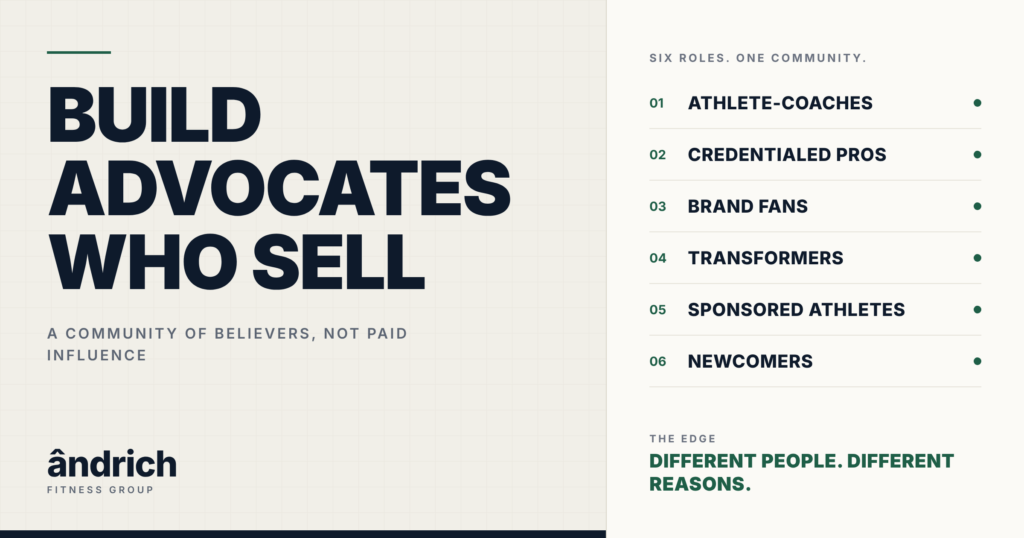
The way to build the full community is to look for different people for different roles. Each role brings something the others cannot, and each has its own reason to belong. There are six.
Athlete-coaches
These are people who pushed themselves to compete and now coach other athletes and everyday clients on how to get results. They have to be able to teach, because the value is access to their clients: sign one coach and you reach everyone they train. The best candidates build meal plans and training plans that become a lifestyle. They are lifestyle coaches first, and what matters most is that they show people with no experience how to move to a healthier way of living.
Credentialed professionals: coaches, PhDs, RDs and RNs
These advocates may never have competed, but their credentials add credibility that a physique alone does not. They also add search value. Content that carries a registered dietitian’s or nurse’s name, whether it is written by them, reviewed by them or contributed by guest writers, gives your site and your online presence the expert signal that search engines and AI answer engines look for.
Brand fans
Good customers who want to be associated with the brand, its products and its values. They already buy and already talk about you. A program gives them a way to do it with recognition, which turns satisfaction into advocacy.
Transformers
Real people who changed their lifestyle and can advocate from experience. They are proof that change is possible, and they speak to the buyer who sees themselves in a before photo and not on a stage. Have them describe their own experience and keep claims within what you can support.
Sponsored athletes
Competitors who form a brand team and represent you at events, on stage and in the community. They carry your name through a season and give the rest of the community someone to look up to. The team section below covers how to build one.
Newcomers
People new to competition or to health and fitness who want to belong to a brand that represents their new identity. Many are hungry for it. They are a natural fit for the store-route tier, where they visit accounts, or for working events, and they are the pool you promote from as they grow.
Why the roles work together
Each role feeds the others. Sponsored athletes give coaches and customers someone to aspire to. Coaches and credentialed professionals give athletes and customers a trusted source. Transformers show the next buyer that regular people succeed. Newcomers and brand fans supply the energy and the numbers, and the best of them move up. A brand that runs one role has a few expensive posts. A brand that runs all six has a community, and a community is the part competitors cannot copy.
Who belongs in your program
The test for an advocate is simple: would your buyer believe this person when they say they use the product? In health and performance, that points to bodybuilding, physique, sports and wellness creators, not generic lifestyle accounts.
Category-native beats big
A competitor, a coach or a serious lifter speaks to an audience that already shares your buyer’s habits. Their followers ask training and nutrition questions in the comments, share their own prep experiences and tag friends. That behavior is worth more than a larger audience that scrolls past.
Smaller accounts also tend to engage more. Benchmarks vary by source and platform, but they point the same direction: one 2026 Instagram dataset puts micro-influencers (10K to 100K followers) at an average 2.4% engagement rate and macro-influencers (100K to 1M) at 1.6% (Dash Social). Treat any benchmark as a starting point, then measure each candidate directly.
Emerging often beats established
Athletes who already carry several major supplement sponsors are expensive and rarely loyal to any one of them. Rising competitors who place well, take their nutrition seriously and have not yet been signed tend to grow with the brand, and they value the credibility of being sponsored.
Match the platform to the buyer
Instagram, YouTube, TikTok and podcasts each reach buyers differently. Instagram carries physique and contest-prep communities. YouTube suits long-form education and product breakdowns. TikTok reaches new audiences quickly. Podcasts build trust through long, conversational endorsements. A good program picks the platforms where your buyer already pays attention rather than trying to be everywhere.
How to verify a creator before you contact anyone
Verification happens before outreach, not after the first invoice. A sound check uses public data and four questions: are the followers real, is the engagement real, does the content fit your product, and is the creator already tied to a competitor?
Check the numbers directly
Calculate engagement yourself from the creator’s recent posts rather than trusting a screenshot or a media kit. Use the interactions each platform makes public, and divide by the base that is reliably visible:
Instagram: average likes plus comments on the last three non-pinned posts, divided by followers.
YouTube: average likes plus comments on the last ten uploads, divided by average views.
TikTok: average likes, comments and shares on the last ten videos, divided by average views.
Skip pinned posts because they skew the average, and never estimate a hidden number. The formulas differ by platform, so never compare an Instagram rate to a TikTok rate. Report the platform next to every figure.
Watch for the usual red flags: follower spikes with no matching content, high follower counts with very low comments, and comment sections full of generic emoji. Those patterns point to bought reach.
Read the feed, not the bio
Open the last nine to twelve posts and note what the creator actually posts: training, nutrition, meal prep, supplement reviews, contest prep, coaching or lifestyle. A creator whose feed regularly includes food, supplements and contest preparation is a natural fit for a nutrition product. A feed of aesthetic lifestyle content with no nutrition angle will make an integration feel forced. Pay attention to the comments too. Followers who ask questions and share their own experience signal an audience that listens.
Screen for conflicts and dilution
Search the creator’s own captions and hashtags for competing brands, then run a general search on the creator’s name plus your category. A creator promoting three or more brands at once dilutes every one of them. An exclusive deal with a direct competitor is usually a disqualifier.
Document what you measured
Record each result with the method beside it, for example the posts sampled and the follower count at the time. When a creator is renewed, replaced or questioned, you can show how the decision was made.
How to build a sponsored athlete team
A sponsored athlete team is a long-term roster, not a set of one-off creators. It works best for sports supplement, functional food and performance brands whose buyers follow the physique sports closely.
Decide what the team is for
Before you recruit, write down the job. Athletes represent the brand at competitions, in content and in the community. A team is a different deal from an influencer post: the athlete carries your name through a full competitive season, and you support them in return.
Build the roster across divisions
NPC and IFBB competitors span divisions with different audiences, including bikini, wellness, fit model, men’s physique, classic physique and bodybuilding. Spreading the roster across divisions lets the brand reach several communities instead of one. Set the target mix first, then select toward it.
Qualify on credibility, not follower count
Look for athletes who are active competitors, placing well at the regional or national level, and posting prep and nutrition content regularly. Confirm they have no competing exclusive deal and no brand-safety concerns. A modest following is fine if the engagement and the credibility are real.
Structure the package
Most emerging competitors fund their own seasons, so support has real value to them. A typical package combines a monthly product supply, branded gear, a cash retainer or partial contest and travel support, and official team status with features on your channels. Scope it to what the brand can sustain for the full term, because a team that is cut mid-season costs more in goodwill than it saves.
Keep the team connected
Athletes stay loyal when they feel part of something. A team page, shared content calendar, regular check-ins and recognition at shows turn a roster of individuals into an actual team, and that is what makes the audience see the brand as a community rather than a sponsor list.
Your field team: store-route advocates
Specialty retail runs on relationships. For brick-and-mortar specialty accounts, your store-route advocates are your field team: they visit stores, hand out samples and talk with the people who sell your product. The goal is a relationship, not a demo. Specialty is also your proving ground, because success there builds the credibility to be taken seriously by more mainstream accounts. The tougher the category, the more the field team matters, and energy drinks, the most competitive market of all, make it essential. Store associates recommend products they know and the people behind them, and an associate who feels good about your brand is a salesperson you do not have to pay.
How a route works
This is not a demo play where someone stands in a store for hours. Each advocate gets a route, for example four stores in a day, and drives to each one and spends about 20 minutes. In that time they introduce themselves to the manager, hand out samples to associates, answer questions about the product and the category, and move on. Repeat visits on a set cycle build familiarity, and familiarity is what turns a sample into a recommendation.
Why it is economical
A staffed demo ties one person to one store for hours. A route lets one person reach several stores in the same day, so the cost per store contact is lower and the program can cover more of your retail footprint. It also puts a face on the brand in every location that carries it.
What the advocate says
Route advocates are trained on what the product is, who it is for, how it compares honestly with the alternatives, and which claims are approved. They do not talk bad about other brands or products. In fact, they should have enough experience to speak about other products they’ve used, which is how a friend would speak to a friend. They also listen. Associates tell them how the product is selling and what customers ask, which is useful field intelligence for your sales team.
The ladder
A route is an entry point, not a dead end, and a natural first job for newcomers who want to belong to a brand. Advocates who show up reliably and get results earn more perks and move up the community: larger territories, bigger product allocations, gear, event access, and eventually a place on the sponsored team or a coaching role. That gives every advocate a reason to perform and gives the brand a bench of proven people to promote from.
Rules of the road
Check each retailer’s policy on vendor visits and sampling, and go through the buyer or category manager where required. Keep advocates to approved claims, require disclosure of the brand relationship wherever they talk about the product online, and have them log every visit with the store, the people met, the samples left and any follow-up.
What to settle in writing before anyone posts
Most disputes in creator programs trace back to terms that were never written down. A clear agreement tells everyone what is expected and protects the brand if something goes wrong. We are not lawyers, and your counsel should review the final paper, but five terms belong in every agreement.
Deliverables and timing
Spell out what the creator will produce: how many posts, videos or appearances, on which platforms, by which dates, and how revisions work. Vague deliverables are the most common source of disappointment on both sides.
Usage rights
Decide whether you may reuse the creator’s content in paid ads, on your site, in email or at retail, and for how long. Rights are often priced separately from the post itself, so settle them up front.
Exclusivity
Define which competing brands or categories the creator cannot promote, and for how long. Narrow exclusivity is easier to get and easier to enforce than a blanket ban.
Compensation and product
State the fee, the payment schedule, the product supply and any bonuses tied to results. When creator fees are paid directly by the brand, every advocate has a known cost.
FTC disclosure and claims
This is where brands get exposed. The FTC requires clear disclosure of any “material connection” between a brand and an endorser, which includes payment, free or discounted product and family or employment ties. The FTC’s guidance says the disclosure belongs with the endorsement itself, must be hard to miss, and should not be buried in a block of hashtags or behind a “more” link. In a video, it should appear in the video and not only in the description (FTC, Disclosures 101).
The same guidance says endorsers cannot discuss a product they have not tried, cannot praise a product they found poor, and cannot make claims that would require proof the advertiser does not have, such as scientific proof that a product treats a health condition. For supplement brands this matters a great deal. Your agreement should require disclosure on every post, ban unapproved health claims, and give you the right to review content and require corrections.
How to measure what advocates actually sell
If you cannot trace sales to a creator, you cannot tell which advocates to expand and which to replace. Build the tracking before the first post goes live.
Give every advocate a trackable path
Assign each creator a unique discount code, affiliate link or both, and tag orders by channel in your store and analytics. Codes capture buyers who purchase later or on another device, and links capture clicks. Using both gives a fuller picture than either alone.
Report on a fixed rhythm
Review results monthly by creator, platform and code. The report should show content delivered, reach, engagement and code or link sales, so you can compare advocates on the same terms. Add the cost of each advocate, including fees and product, and you can see cost per sale.
Act on the numbers
Top performers get expanded: more deliverables, longer terms or a bigger role on the team. Underperformers get a conversation about content and fit, and if results do not improve they get replaced. This is the discipline that keeps a program from drifting into a list of free-product recipients.
Read the program, not just the post
Some advocates drive sales directly. Others, such as coaches and athletes, build credibility that raises conversion elsewhere. Track direct sales first, but also watch branded search, repeat purchase and retail velocity over a full season. A program is working when it moves those numbers over time, not only when one post spikes.
Measure the store route
Log each visit by store, date, people met and samples left, then compare the stores on a route with their sell-through before and after. Retail velocity is the number that matters here, because the route exists to make associates recommend the product. Advocates whose stores move up get more territory. Those whose stores do not get coaching, then a new route.
What a program costs and who should run it
Budget a program in four lines, and keep them separate so you always know what each advocate costs.
| Cost line | What it covers | Who pays |
|---|---|---|
| Creator and athlete fees | Retainers, per-post fees, bonuses | Brand, directly to the creator |
| Product seeding | Monthly supply, samples, gear | Brand |
| Contest and travel support | Entry fees, partial travel for sponsored athletes | Brand |
| Program management | Sourcing, vetting, outreach, contracts, calendars, reporting | In-house team or an operator |
The first three scale with the size of your roster, and a store-route tier adds mileage, a modest stipend and sample cost for each route advocate. The fourth is the one most brands underestimate. Someone has to source and verify candidates, negotiate, brief creators, chase deliverables, manage codes and build the monthly report. If that falls on a founder, it stops happening within a quarter.
Start smaller than you think
A focused roster of well-vetted advocates will outperform a long list of loosely managed ones. Begin with a handful of the right people across one or two platforms, learn what converts, and then expand the winners.
Decide who will run it
You have three options: build the capability in-house, hire an agency that sells reach, or work with an operator who has run these programs inside real brands. The right choice depends on whether you have someone with the time, the contacts and the category knowledge to own it every week. If you do not, the next section explains what an operator does.
Working with Andrich Fitness Group on brand advocacy
We build and run brand advocacy programs for health and performance brands, from sourcing through sell-through, inside your commercial strategy. We do not run a talent agency. The work is led by Vince Andrich, who has spent more than 25 years building advocacy for brands including Quest Nutrition, Bang Energy, JYM Supplement Science, PROGENEX, GNC, EAS, MET-Rx, Body-for-LIFE and Muscle Media.
How the engagement runs
Brand and buyer brief. We define who you are selling to, what the advocate needs to stand for and the story they will tell, built on the Commercial Narrative Framework.
Sourcing and verification. We build a shortlist across Instagram, YouTube, TikTok and podcasts, then verify authenticity, engagement, content fit and brand conflicts before anyone is contacted.
Outreach and agreements. Personalized outreach, negotiation and agreements that lock in deliverables, rights and tracking.
Launch and seeding. Product seeding, content briefs, codes, store routes and a content calendar so advocates launch together and stay consistent.
Manage, measure, optimize. Monthly reporting on content, reach and code sales. Top performers are expanded and underperformers are replaced.
How it is priced
A monthly retainer covers program strategy, sourcing, vetting, outreach, contracts, management and reporting, scoped to roster size and platforms. Creator fees and product seeding are paid directly by the brand to the creators, with no markup, so you can see exactly what each advocate costs. You receive a monthly review by creator, platform and code.
A strong fit
A sports supplement, functional food or RTD, or performance brand
A product athletes and serious lifters will actually use
Budget for product seeding and creator compensation
A goal of building a program, not running a one-off campaign
A way to track results by code, link or channel
Not a fit yet
You are chasing follower counts over buyer fit
There is no budget for creator fees or product
You expect one post to go viral
You cannot track sales from creators
The product cannot hold up to athlete scrutiny
Frequently asked questions
What is brand advocacy for a supplement or performance brand?
Brand advocacy is a managed program in which verified athletes, coaches and customers recommend your product on an ongoing basis. Unlike a one-off influencer post, the same trusted voices represent the brand over time, and each one is tracked by code or link so results can be measured.
How is brand advocacy different from influencer marketing?
Influencer marketing usually buys individual posts for reach. Brand advocacy builds a roster and a community with defined roles, agreements and reporting. The goal is sales and credibility that compound, not a single burst of impressions.
How do I know if a creator’s followers are real?
Calculate engagement yourself from recent posts, compare it with the follower count, and read the comments. Sudden follower spikes, very low comments on large audiences and generic emoji replies are warning signs. The FTC’s Consumer Reviews and Testimonials Rule, effective October 21, 2024, also prohibits knowingly buying or selling fake indicators of social media influence.
What engagement rate should I look for?
It depends on platform and account size, and the formulas differ by platform, so never compare across them. Smaller accounts generally engage at higher rates than larger ones. Use published benchmarks as a reference, then compare each candidate against others on the same platform.
Do sponsored athletes and creators have to disclose the relationship?
Yes. The FTC requires clear and conspicuous disclosure of any material connection, which includes payment, free or discounted product and family or employment ties. The disclosure must be hard to miss and placed with the endorsement itself.
What should be in a creator agreement?
Deliverables and dates, usage rights, exclusivity, compensation and product, FTC disclosure requirements, and a ban on unapproved health claims. Have your attorney review the final document.
How do I measure whether advocates are driving sales?
Give each advocate a unique code or affiliate link, tag orders by channel, and review results monthly by creator, platform and code. Expand the advocates who sell and replace those who do not.
Is my brand ready for an advocacy program?
You are ready if you sell a product athletes and serious lifters will use, you have budget for creator fees and product seeding, you want a program rather than a single campaign, and you can track sales by code, link or channel.
What is a store-route advocate?
A store-route advocate is a brand representative who visits a set list of retail stores, typically a handful per day for about 20 minutes each, to hand out samples and talk with sales associates. It is a relationship play, not an hours-long in-store demo, and it is an entry rung on the advocacy ladder.
Build advocates who actually sell
Book a 30-minute discovery call. We will look at your brand, your buyer, and the creators and athletes who can move them. Book a Discovery Call. No pitch, no commitment.
Sources
FTC, Consumer Reviews and Testimonials Rule: Questions and Answers
Nielsen, Beyond martech: building trust with consumers (2021 Trust in Advertising study)
SupplySide Supplement Journal, Experts give high marks to P&G’s bet on Thorne
Nutritional Outlook, Procter & Gamble to Acquire Thorne for $3.8 Billion
Phil Knight, Shoe Dog: A Memoir by the Creator of Nike (Scribner, 2016)
